
MOHANTHAL
(Roasted Gram Flour Fudge)

Recipe Overview
Mohanthal is a rich, traditional and grainy gram flour fudge (Besan Barfi)
originating from the western Indian states of Gujarat and Rajasthan and widely
enjoyed in Sindhi–Bhatia homes. Named after Lord Krishna — where Mohan is
another affectionate name for Krishna and Thal refers to a plate or offering —
this sweet is commonly prepared as Prasad and is especially popular during festivals
such as Janmashtami, Diwali, and family celebrations.
Unlike smooth Besan Barfi, Mohanthal is prized for its signature danedar (granular) texture,
deep roasted aroma, and rich flavour enhanced with ghee and fragrant spices.
Some households also prepare a softer semi-liquid version known as Dhilo Mohanthal,
which is served in bowls or cups during celebratory gatherings.
Recipe Details
– Cuisine: Sindhi–Bhatia / Gujarati–Rajasthani
– Course: Dessert / Festive Sweet
– Diet: Vegetarian
– Servings: 12–16 pieces
– Preparation Time: 20 minutes
– Resting Time: 15–20 minutes
– Cooking Time: 35–40 minutes
– Setting Time: 2–3 hours
– Difficulty Level: Moderate
Ingredients
Main Ingredients
– Gram Flour (Besan) – 200 gms.
– Ghee – 50 gms.
– Milk – 1 cup
– Sugar – 150 gms.
– Water – 150 ml
For Greasing
– Ghee – ½ tsp.
Garnish Ingredients
– Poppy seeds – 5 gms.
– Chopped almonds or pistachios – optional
Method
Step 1: Prepare the Dhrabo (Texturing Process)

– Place the gram flour in a bowl.
– Add a few spoons of warm milk and a little melted ghee.
– Rub the mixture thoroughly between your palms until it resembles coarse breadcrumbs.
– Allow it to rest for approximately 15 minutes.
– Pass the mixture through a coarse sieve to create small uniform granules.
– This process gives Mohanthal its characteristic grainy texture.
Step 2: Roast the Gram Flour


– Heat ghee in a heavy-bottomed kadai over a low flame.
– Add the sieved gram flour mixture and roast slowly, stirring continuously.
– Continue roasting until the flour turns deep golden-brown with a biscuit-like
aroma and nutty fragrance.
Step 3: Prepare the Sugar Syrup

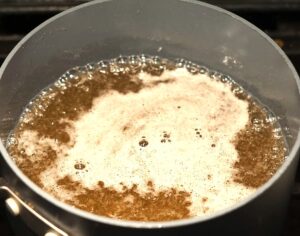
– In a separate vessel, combine sugar and water.
– Heat on a medium flame and stir until the sugar dissolves completely.
– Cook until the syrup reaches one-string consistency.
Step 4: Combine the Mixtures
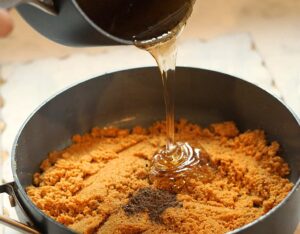

– Slowly pour the hot sugar syrup into the roasted gram flour mixture while
stirring continuously.
– Mix thoroughly until the mixture thickens and starts leaving the sides of the pan.
Step 5: Set the Mohanthal

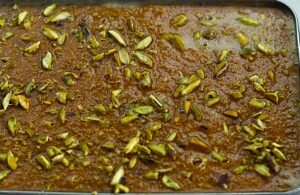
– Lightly grease a thali with ghee.
– Transfer the mixture into the greased thali and spread evenly using a flat spatula.
– Sprinkle poppy seeds and chopped nuts over the top while still warm.
– Allow the Mohanthal to cool completely and set.
– Cut into squares or diamond-shaped pieces.
To Serve
Mohanthal can be served:
– As a dessert after meals
– During tea-time with Motichanna – https://panjakhada.com/moti-channa/
or Besan / Sev – https://panjakhada.com/besan-sev/
– As Prasad during religious ceremonies and festive occasions
Chef’s Tip
– The Dhrabo process is the secret behind authentic Mohanthal.
– Rubbing the flour with milk and ghee before roasting creates the desired danedar (grainy)
texture. Skipping this step may result in a smoother Besan Barfi rather than
traditional Mohanthal.
– Slow roasting is equally important — rushing this stage may leave a raw flour taste.
Nutritional Insight
– Gram flour is a good source of plant protein and dietary fibre
– Ghee contributes richness and healthy fats
– Nuts provide additional protein, minerals, and healthy fats
As Mohanthal is rich in ghee and sugar, it is best enjoyed in moderation.
Cultural Significance
Mohanthal has deep religious and cultural roots and is traditionally prepared as Prasad,
particularly during Janmashtami, celebrating the birth of Lord Krishna.
In many homes, it represents abundance, devotion, and festive joy.
Storage & Make-Ahead Tips
– Cool completely before storing
– Store in an airtight container at room temperature
– Shelf life: 10–15 days
– Refrigeration can extend shelf life but may slightly firm the texture
Variations

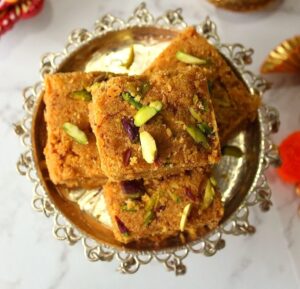
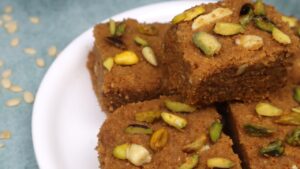
– Dhilo Mohanthal: Softer semi-solid version served in bowls or cups
– Dry Fruit Mohanthal: Add almonds, pistachios, or cashews
– Saffron Mohanthal: Add saffron strands for festive flavour
– Jaggery Mohanthal: Replace sugar with jaggery for a deeper flavour profile
Did You Know?
The signature grainy texture of Mohanthal is not accidental — it is intentionally created
through the traditional Dhrabo technique, making it distinctly different from smooth
Besan Barfi. The tiny granules are considered a hallmark of an authentic Mohanthal.