
BOONDI JA LADOO
(Sweet Gram Flour Dumpling Balls)

Recipe Overview
Boondi Ja Ladoo is a traditional Indian festive sweet made from tiny fried gram flour pearls
soaked in saffron-infused sugar syrup and shaped into soft, aromatic laddoos.
Popular across celebrations, weddings, temples, and festive gatherings, these laddoos
are especially cherished as prasad and festive mithai. The word Boondi comes from
the Hindi word boond, meaning “drop,” referring to the tiny pearl-shaped dumplings
created using a perforated ladle (jharan).
Ingredients
For the Boondi
– Gram Flour (Besan) – 100 gms.
– Water – approx. 30 ml.
– Ghee – for frying
– Almonds – 4 nos. (finely chopped)
– Pistachios (unsalted) – 4 nos. (finely chopped)
For the Sugar Syrup
– Sugar – 100 gms.
– Water – 100 ml.
– Saffron – 1 gm.
For Garnish
– Edible Silver Leaves (Varq) – 2 sheets
– Chopped Almonds & Pistachios – as required
Method
Step 1: Prepare the Sugar Syrup

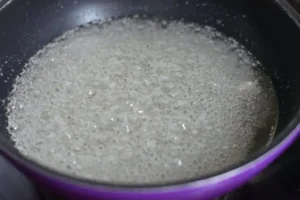
– In a pan, heat water and add the sugar and saffron.
– Stir continuously till the sugar dissolves completely.
– Cook till the syrup reaches a 2-string consistency.
The syrup for laddoos should be thicker than the syrup used for regular sweet boondi.
– Keep the syrup warm on a low flame.
Step 2: Prepare the Boondi Batter

– In a bowl, combine gram flour and water to form a smooth batter of
thick pouring consistency.
– Ensure there are no lumps in the batter.
Step 3: Fry the Boondi


– Heat ghee in a kadai on a medium flame.
– Hold a jharan (perforated ladle) slightly above the hot ghee.
– Pour a little batter onto the ladle and allow it to drip naturally through the holes
into the hot ghee.
– Avoid pressing the batter with your hands or spoon, as this may distort the
round shape of the boondi pearls.
– Fry till the boondi turns firm and light golden-yellow in colour.
– Remove onto absorbent paper and allow it to cool for about 5 minutes.
– Repeat till all the batter is used.
Step 4: Soak and Shape the Laddoos
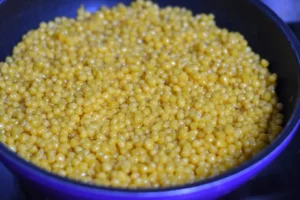
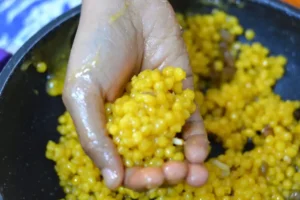
– Add the cooled boondi to the warm sugar syrup.
– Allow the boondi to absorb the syrup completely until it becomes soft and sticky.
– While still warm, take portions in your palms and gently shape them into round laddoos.
– Garnish with edible silver leaves and finely chopped almonds and pistachios.

Critical Tips for Success
– Batter Consistency: If the batter is too thin, the boondis will turn flat. If too thick,
they will form elongated droplets with tails instead of round pearls.
– Frying Temperature: The ghee should be moderately hot so the droplets puff instantly
when dropped. Cold oil causes greasy and flat boondis.
– Texture Control: Avoid over-frying. Slightly soft boondi absorbs syrup better and creates
juicy laddoos, whereas overly crisp boondi results in dry laddoos.
– Syrup Temperature: Always mix the boondi into warm syrup to ensure proper
absorption and binding.
Chef’s Tips
– A teaspoon of melon seeds or tiny cloves can be added for festive flavour variations.
– For softer laddoos, cover them with a cloth for 30 minutes after shaping.
– A pinch of cardamom powder or edible camphor may be added for a
traditional temple-style aroma.
– To make Motichoor Ladoo, use a finer perforated ladle to create tiny boondi pearls.
Nutritional Insight
Boondi Ja Ladoo is an energy-rich festive sweet made primarily from gram flour,
which provides plant-based protein and iron. Ghee contributes richness and flavour,
while saffron and nuts enhance the nutritional value with antioxidants and healthy fats.
Traditionally, laddoos were often prepared during festivals and family celebrations as a
symbol of abundance and hospitality.
Cultural Significance
Boondi Laddoos hold a special place in Indian festive traditions and temple offerings.
They are commonly distributed during weddings, religious ceremonies, birthdays,
and celebrations. In many Bhatia and Sindhi households, homemade laddoos are
associated with joyous occasions, blessings, and community gatherings. Their bright
golden colour symbolizes prosperity and auspicious beginnings.
Boondi Ladoo vs. Motichoor Ladoo

Though both sweets are made using gram flour pearls soaked in sugar syrup,
the primary difference lies in the size of the boondi.
– Motichoor Ladoo: Prepared using a very fine mesh ladle, producing tiny delicate pearls
that create a smoother, softer, and more compact texture.
– Boondi Ladoo: Made using a regular perforated ladle, resulting in larger and distinct pearls.
Variations


– Besan Ladoo: Made by slow-roasting gram flour in ghee and shaping it into rich,
aromatic laddoos.
– Atta Ladoo: Prepared using whole wheat flour roasted in ghee, offering a nuttier flavour
and softer texture.
– Coconut Ladoo: A popular variation made with fresh or desiccated coconut,
often flavoured with cardamom.
– Rava Ladoo: Made with semolina (rava/sooji), sugar, ghee, and nuts, giving a grainy yet
melt-in-the-mouth texture.
– Gaound Ka Ladoo: A traditional winter delicacy prepared with edible gum (gond), whole
wheat flour, nuts, and ghee, valued for its energy-boosting and strengthening properties.
Storage & Make-Ahead Tips
– Store the laddoos in an airtight container at room temperature for 4–5 days.
– Refrigeration can extend the shelf life up to 7–8 days.
– The boondi can be fried a day in advance and shaped into laddoos later.
Did You Know?

Traditional temple-style boondi laddoos are often made using pure desi ghee and
saffron-infused syrup for their distinctive aroma and richness. Loose sweet boondi
is also enjoyed on its own and paired with savoury sev as a classic sweet-and-salty
combination loved across many Indian communities.
To Serve
Boondi Ja Ladoo can be served during lunch or dinner as a festive sweet dish.
It is also traditionally offered as prasad during religious ceremonies and celebrations.